
Explore the depth of history at Historic Sites Near Timber Valley Retreat during your stay.
Welcome to Timber Valley Retreat 🌲, your tranquil haven perfectly positioned to explore the breathtaking history of the Mid-Atlantic region. Our beautiful property is nestled at the crossroads of Maryland, West Virginia, Virginia, and Pennsylvania, offering unparalleled access to some of America’s most pivotal historic sites.
Discover the rich tapestry of Historic Sites Near Timber Valley Retreat and immerse yourself in the captivating stories they tell.
As you explore, you will find various Historic Sites Near Timber Valley Retreat that showcase the heritage of the area.
Each of the Historic Sites Near Timber Valley Retreat offers a unique glimpse into the past.
Exploring Historic Sites Near Timber Valley Retreat
While you are here to relax and recharge, we invite you to enrich your stay with a journey through time ⏳. You don’t have to drive far! We’ve compiled a comprehensive guide to the region’s best historical landmarks, all located within a short 35-minute drive 🚗 of your retreat. From the quiet beauty of the C&O Canal to the hallowed grounds of Civil War battlefields and colonial forts, this guide provides the detail you need to plan your perfect day trip.
Each location offers a unique perspective on American life, war, and industry. By focusing on the story of each site—what you will see, what you will learn, and how to get the most out of your visit https://www.visithagerstown.com/
Make sure you visit the Historic Sites Near Timber Valley Retreat to fully appreciate the local history.
The C&O Canal is one of the key Historic Sites Near Timber Valley Retreat that offers beautiful views and rich history.

Don’t miss the chance to see the Historic Sites Near Timber Valley Retreat that played a vital role in the nation’s history.
Learn about the role of the C&O Canal as one of the Historic Sites Near Timber Valley Retreat during your visit.
With a visit to the Historic Sites Near Timber Valley Retreat, you can explore the rich heritage of the region.
The Power of Place: History Right Outside Your Door 🌳
Our connection to the past is tangible here. The very landscape surrounding Timber Valley Retreat played a critical role in American development and conflict. Understanding this history deepens your appreciation for the tranquil beauty you find today. The convenience of our location means you can easily visit multiple sites in a single day, maximizing your historical exploration.
I. The Closest Connection: The C&O Canal National Historical Park 🛶
The Chesapeake & Ohio Canal isn’t just a nearby park—it is a massive piece of American industrial history that runs parallel to the Potomac River and the Baltimore and Ohio Railroad, often forming the historical backdrop for the region. The C&O Canal towpath is practically in our backyard, making it the most accessible historic site on this list.
A Deeper Dive into the Canal’s History 🚢
Engage with the nature and history intertwined at the Historic Sites Near Timber Valley Retreat.
Built between 1828 and 1850, the C&O Canal was a monumental engineering feat designed to transport goods, primarily coal from the Allegheny Mountains, to the port of Georgetown in Washington, D.C. Spanning 184.5 miles, the canal system required 74 lift locks to navigate changes in elevation, as well as 11 stone aqueducts to carry the canal’s water over major streams and rivers. The canal operated for nearly 100 years before being destroyed by a flood in 1924, its operations officially ceasing in 1933.
Antietam National Battlefield is one of the most significant Historic Sites Near Timber Valley Retreat for anyone interested in American history.
As part of your journey, visit the Historic Sites Near Timber Valley Retreat to deepen your understanding of the Civil War.
Visitor Experience at the Canal (Minutes from the Retreat) 🚴♀️
- Hiking and Biking: The flat, crushed-stone towpath is perfect for cycling, jogging, or a leisurely walk. You can choose a short segment for an easy hour of activity or commit to a longer trek. The historic mile markers make it easy to track your distance.
- The Locks: A fascinating element of the canal are the stone locks. Many of these have been preserved, allowing you to visualize how mule-drawn boats were raised and lowered. This demonstrates the immense human effort and ingenious engineering required to move commerce in the 19th century.
- Wildlife and Nature: The canal corridor is also a beautiful natural sanctuary. Birdwatching 🐦 and observing the local flora and fauna are popular activities along the towpath. This blend of nature and history provides a peaceful, restorative experience.
II. The Hallowed Ground: Antietam National Battlefield 🕊️
Antietam is arguably the most famous historic destination in the region and is a crucial stop for any history enthusiast. It is known as the site of the Battle of Antietam, which occurred on September 17, 1862.
The Significance of One Day (A 30-35 Minute Drive) 🩸
The Battle of Antietam—also known as the Battle of Sharpsburg—remains the single bloodiest day in American military history. Over 23,000 soldiers were killed, wounded, or missing after just twelve hours of fighting. Critically, the Union victory here provided President Abraham Lincoln with the political cover needed to issue the preliminary Emancipation Proclamation. This transformed the war from a conflict to save the Union into a fight to end slavery, changing the course of the nation forever.
Planning Your Visit to Antietam ⛪
- The Driving Tour: The best way to experience the vastness of the battlefield is by taking the 8.5-mile self-guided driving tour. Key stops include:
- The Cornfield: The site of brutal, chaotic morning fighting.
- Dunker Church: A small, simple church that stood in the center of the fighting. It has become an iconic, haunting symbol of the battle.
- The Bloody Lane (Sunken Road): A deeply entrenched farm lane that became a tragic slaughterhouse in the battle’s afternoon phase. Walking this lane is a powerful and sobering experience.
- Burnside Bridge: A picturesque stone bridge over Antietam Creek, famous for the desperate struggle that took place there.
- The National Cemetery: Located near the Visitor Center, this cemetery honors the soldiers who fell here. It is a powerful reminder of the human cost of the conflict.
- Expert Ranger Programs: We highly recommend checking the National Park Service schedule for ranger-led talks. A historian guiding you through the terrain adds unparalleled depth to the experience. 🗣️
III. The Mountain Defense: South Mountain State Battlefield ⛰️
Often overlooked in favor of the more famous Antietam, the Battle of South Mountain was a vital prelude to the main event and is rich with its own unique history and beautiful mountain trails.
The Key to the Campaign (A 25-30 Minute Drive) 🗝️
On September 14, 1862, three days before Antietam, the Union and Confederate forces clashed in three separate mountain passes (Crampton’s Gap, Turner’s Gap, and Fox’s Gap) along South Mountain. This action was critical because Confederate General Robert E. Lee needed to delay the Federal advance to concentrate his scattered forces. The Union victory here was a major morale boost and provided critical intelligence that ultimately led to the confrontation at Antietam.
Exploring the South Mountain Sites 🥾
- Scenic Views: South Mountain is part of the Blue Ridge chain, and the battlefield offers stunning vistas of the Middletown Valley. This area provides an excellent contrast between the intense drama of the fighting and the quiet beauty of the highlands.
- The Appalachian Trail: A section of the legendary Appalachian National Scenic Trail runs directly through the battlefield area. History and nature lovers can combine a scenic hike with historical exploration, walking the same paths where soldiers fought.
- The Monument: The first monument dedicated to Union Major General Jesse L. Reno is located at Fox’s Gap, marking the spot where he was mortally wounded.
IV. The Frontier Fortress: Fort Frederick State Park 🛡️
To travel further back in time, head to Fort Frederick, a beautifully restored stone fort that predates the Revolutionary War and offers a glimpse into colonial America’s frontier life.
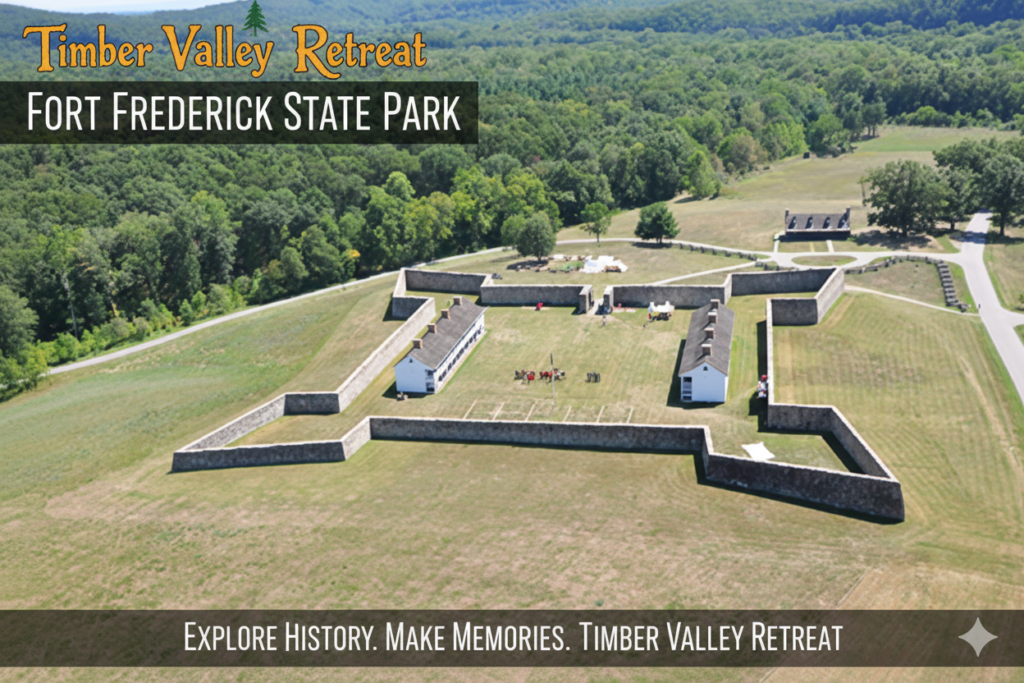
Guarding the Western Frontier (A 15-20 Minute Drive) 🏹
Built in 1756 during the French and Indian War (1754-1763), Fort Frederick was constructed to defend the Maryland frontier against French and Native American attacks. It is one of the best-preserved stone forts of that period in North America. The fort’s design—a massive stone perimeter with bastions at the corners—speaks to the serious threats faced by early American settlers. It was later used as a prison for Hessian and British soldiers captured during the Revolutionary War.
What to See at Fort Frederick 🧱
- The Stone Walls: Walking the perimeter of the formidable stone walls gives you a sense of scale and protection. The walls are still standing, offering a magnificent view over the Potomac River valley.
- Living History: Fort Frederick is renowned for its immersive living history programs 🧑🌾. On weekends throughout the season, staff and volunteers dress in period-accurate attire, demonstrating skills like blacksmithing, cooking, and military drills from the 18th century. Timing your visit for one of these events is highly recommended.
- Barracks and Exhibits: Inside the walls, you can explore reconstructed barracks and a visitor center that features exhibits detailing the lives of the soldiers and settlers who depended on the fort.
V. The Founder’s Home: Jonathan Hager House and Museum 🏡
A visit to Hagerstown—the nearby major city that gives the area its name—must include the house of its founder, providing a look at a slightly different side of colonial and early Federal history.
The Birth of a Town (A 30-35 Minute Drive) 🗓️
The Jonathan Hager House was built in 1739 by Jonathan Hager, a German immigrant and entrepreneur who laid out and founded the town of Hagerstown (originally called Elizabethtown) in 1762. The house is a rare example of German Colonial architecture, featuring a unique stone construction and two entrances—one on the upper floor facing the hillside, and one on the lower floor. Hager was a major landowner and military figure in the area.
A Look into 18th Century Domestic Life 🛋️
- Architecture: The two-story stone house itself is the main exhibit. Its construction reveals the techniques and materials available to prosperous frontier settlers in the mid-18th century.
- Museum Interpretation: The interior is furnished with authentic and reproduction pieces, interpreted to show what life was like for Hager and his family. The museum highlights the blending of German and English cultural influences in the region.
- Gardens: The surrounding property includes beautiful colonial-era gardens 🌷 and grounds, perfect for a short, peaceful stroll before exploring the rest of the town.
VI. The Nation’s First Monument: Washington Monument State Park 🗽
The Jonathan Hager House is a must-see among the Historic Sites Near Timber Valley Retreat.
This is a chance to see a truly unique piece of American history—the first monument ever dedicated to the nation’s first president, George Washington.
Explore the Historic Sites Near Timber Valley Retreat that shaped the community.
Built by Citizens (A 25-30 Minute Drive) 🧑🤝🧑
The Washington Monument atop South Mountain near Boonsboro, MD, was not commissioned by the government but by the citizens of Boonsboro themselves. On July 4, 1827, local townspeople gathered and, through a single day of organized effort, built the original 30-foot stone tower. It was repaired and slightly rebuilt in the following decades and officially transferred to the State of Maryland in the 1930s.
The Panoramic Reward 🔭
- The Climb: Visitors can climb the stone spiral staircase to the top of the tower for a remarkable 360-degree view of the surrounding valleys, including the Middletown Valley, the vast expanse of the Appalachian Mountains, and on a clear day, portions of the Antietam Battlefield.
- A-T Views: Like the South Mountain Battlefield, this park intersects with the Appalachian Trail, making it another excellent spot to combine hiking with history. The views alone make this worth the short drive.
- Museum and Park: The site includes a small museum detailing the monument’s history and the efforts of the local citizens. It is a fantastic place for a picnic 🧺, offering several picnic areas throughout the park.
VII. The Historic Towns: Shepherdstown and Harpers Ferry (Bonus Sites) ✨
While these two sites might push the 35-minute boundary depending on traffic, we would be remiss not to mention them, as they are essential historical anchors of the region and offer vibrant, historical atmospheres. They are well worth the slightly extended drive (typically 35-45 minutes).
Shepherdstown, WV: The Oldest Town 🏘️
Visit the Historic Sites Near Timber Valley Retreat to learn about the area’s rich culture.
Shepherdstown, the oldest town in West Virginia, is a charming and historically preserved town on the Potomac River. It served as a critical hospital town after the Battle of Antietam, where thousands of wounded soldiers were brought for care. The town has a bustling historic main street filled with unique shops, local restaurants 🍽️, and historic homes. It is a fantastic place to spend an afternoon enjoying lunch and imagining the scenes of 1862.
Harpers Ferry, WV: Crucible of Conflict 🏞️
Harpers Ferry is a National Historical Park at the confluence of the Potomac and Shenandoah Rivers. It is famous for John Brown’s Raid in 1859, a pivotal event that hastened the start of the Civil War.
- The Views: The scenery is spectacular, with steep mountains rising above the water.
- The Lower Town: The historic lower town has been restored to its 19th-century appearance, with museum exhibits in the buildings that detail John Brown’s raid, the Civil War, and early industry.
- A Rich Experience: You can spend an entire day here exploring the museums, hiking the surrounding trails, and simply standing at the point where the two rivers meet—a true historical and geographical marvel.
Planning Your Historical Itinerary from Timber Valley Retreat 📝
One of the great advantages of staying at Timber Valley Retreat is the ability to customize your historical exploration. Here are a few itinerary ideas to help you get started:
Take time to visit the Historic Sites Near Timber Valley Retreat for a well-rounded experience.
As you plan your journey, consider the various Historic Sites Near Timber Valley Retreat that await you.

Itinerary 1: The Civil War Deep Dive ⚔️
Shepherdstown offers a glimpse into the past among the Historic Sites Near Timber Valley Retreat.
Harpers Ferry highlights another important chapter in the Historic Sites Near Timber Valley Retreat.
- Morning: Visit Antietam National Battlefield. Take the driving tour and dedicate time to walking The Bloody Lane and visiting the Dunker Church.
- Lunch: Enjoy a meal at a local restaurant in the nearby historic town of Sharpsburg.
- Afternoon: Drive a short distance to South Mountain State Battlefield. Take a hike along the Appalachian Trail segment and reflect on the actions that led up to Antietam.
Itinerary 2: The Colonial and Frontier Experience 🧑🍳
- Morning: Immerse yourself in the 18th century at Fort Frederick State Park. Plan your visit to coincide with a living history demonstration for the best experience.
- Lunch: Head into Hagerstown for a quick, local lunch.
- Afternoon: Visit the Jonathan Hager House and Museum to see the founding father’s unique German Colonial home and explore the beginnings of the city.
Itinerary 3: History, Nature, and Views 🏞️
- Morning: Drive to Washington Monument State Park. Climb the tower for your panoramic view and take a short hike on the Appalachian Trail.
- Lunch: Have a relaxing picnic lunch in one of the State Park’s shaded areas.
- Afternoon: Return to the immediate area of Timber Valley Retreat and spend a peaceful few hours walking, biking, or relaxing on the C&O Canal Towpath, watching for wildlife and appreciating the quiet flow of the Potomac River.
Conclusion: Your Retreat, Your History 💖
Your itinerary should include visits to the Historic Sites Near Timber Valley Retreat for an enriching experience.
We understand that your time at Timber Valley Retreat is precious—a chance to disconnect from the modern world and connect with nature and loved ones. These historic sites, all easily accessible, offer a meaningful and enriching way to spend a few hours or a whole day. They allow you to not only relax in the present but also appreciate the depth and drama of the past that surrounds us.
We are proud to be located in such a historically significant area and encourage you to take advantage of the numerous stories waiting to be discovered just minutes away. Your retreat is not just a getaway; it’s a gateway to some of the most important chapters in American history.
We look forward to welcoming you and hearing about the discoveries you make on your historical excursions.
Don’t forget to capture the essence of Historic Sites Near Timber Valley Retreat during your visit.
The beautiful views found at the Historic Sites Near Timber Valley Retreat provide a stunning backdrop for your explorations.
Book your stay at Timber Valley Retreat at https://timbervalleyretreat.com/ and come experience the history in Washington County, Maryland and the tri-state area.

Ultimately, the Historic Sites Near Timber Valley Retreat will enrich your time at the retreat.
Plan to visit the Historic Sites Near Timber Valley Retreat to deepen your appreciation of the past.
Your journey into history begins at the Historic Sites Near Timber Valley Retreat.
Visit us and discover the Historic Sites Near Timber Valley Retreat that make our region unique.