
Exploring the deep history of Washington County is a breathtaking experience, especially when you are just steps away from the Potomac River. The historic Charles Mill ruins, precisely located at Mile 108.13 of the C&O Canal, offer a stunning glimpse into Maryland’s industrial past. These stone walls tell a story of grit, commerce, and the relentless flow of time. Today, we are sharing 9 extraordinary secrets about this sanctuary. 🌿✨
1. The Precise Marker: Why Mile 108.13 Matters to C&O Canal History 📍
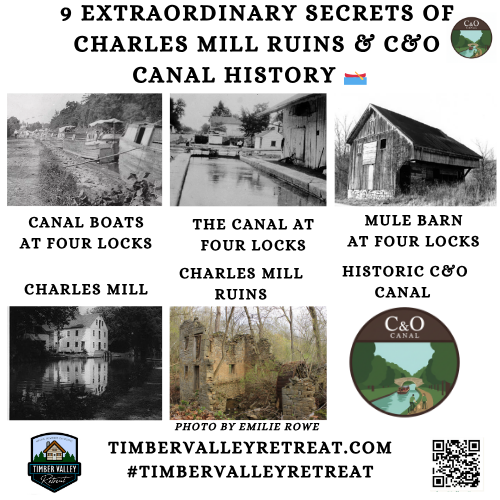
While many people know the general area of Four Locks, the Charles Mill ruins (historically referred to as the Shervin Mill) sit at a very specific point on the map: Mile 108.13. This location was not accidental. In the 1800s, the placement of a mill was a strategic engineering decision based on water access and proximity to the canal’s infrastructure. Being situated here allowed the mill to act as a vital landmark for canal boatmen who were navigating the long stretches between Williamsport and Hancock. 🛶
2. The Power of Big Spring Run at the Charles Mill Ruins 💧
The “green” sanctuary of our retreat is defined by its water. Historically, the Charles Mill ruins represent a marvel of 19th-century hydro-power. It was fueled by the steady, powerful flow of Big Spring Run. This same water still winds its way through our property today, serving as a living link to C&O Canal history. In its heyday, this water-driven energy was the heartbeat of the local economy, turning massive stones to grind grain into flour that would eventually travel all the way to Georgetown.
3. A Thriving 19th-Century Hub of C&O Canal History 🏛️
In the mid-to-late 1800s, this area was far from the quiet retreat it is today. It was a buzzing center of commerce. Joel Charles operated a general store here in 1875, and the mill complex was surrounded by warehouses and hay sheds. It was a place where local farmers met canal workers, exchanging news and goods. When you walk the paths near the Charles Mill ruins today, you are walking through the “downtown” of a bygone era.
4. The Canal Connection and Prather’s Neck 🗺️
The survival of the mill depended entirely on the C&O Canal history being written at the time. Located just downstream from the famous Four Locks (Locks 47-50), the mill was part of a shortcut across Prather’s Neck. The canal company famously dug through this neck of land to save four miles of river travel. The Charles Mill ruins stand as a reminder of how businesses positioned themselves to serve the influx of boats that utilized this engineering shortcut. 🏗️
5. Architectural Mastery: The Masonry of the Charles Mill Ruins 🧱
One of the most awe-inspiring aspects of the Charles Mill ruins is the masonry. These are not just piles of rock; they are examples of 19th-century industrial architecture preserved within C&O Canal history. The rugged stone walls were built to withstand the vibration of heavy machinery and the occasional flooding of the Potomac. Even now, without a roof or floors, the verticality of the ruins at Mile 108.13 serves as a testament to the laborers who built this country.
6. The “Cove” and the Potomac River 🌊
Just a short distance from the stone walls of the Charles Mill ruins lies “The Cove,” a tranquil area where the Potomac River slows down. Historically, this proximity was vital for transport, but today it provides a sensory experience for our guests. The transition from the solid, silent stone of the ruins to the shifting, melodic water of the river is part of what makes this landscape so restorative. 🛶

7. Civil War Gravity and C&O Canal History ⚔️
The C&O Canal was a frequent target during the Civil War. Confederate forces often attempted to disable the canal to cut off supplies to Washington, D.C. The stretch around the Charles Mill ruins at Mile 108.13 was heavily guarded by Union militia. These ruins stood through these turbulent times, witnessing the movement of troops and the tension of a nation divided. You can learn more about the strategic importance of this area on the Official C&O Canal National Historical Park website.
8. The Reclamation of the Enchanted Forest 🌳
Nature has a beautiful way of reclaiming what was once industrial. Today, the area surrounding the Charles Mill ruins is what we call the “Enchanted Forest.” Sycamore trees and wild flora wrap around the stone, creating an evergreen atmosphere that changes with the seasons. It has become a premier spot for photography, where the gray of the historic stone contrasts perfectly with the vibrant greens of the Maryland spring. 📷
9. A Journey of Discovery into C&O Canal History 🚶♂️
The final secret of the Charles Mill ruins is that they are best experienced on foot. Accessible via a gentle morning walk along the towpath, the site invites visitors to slow down and connect with C&O Canal history. There are no loud crowds or modern distractions here—just the sound of the wind through the trees and the quiet dignity of history. 🦅
The Lost Community of Four Locks: Life on the “Neck” 🏘️
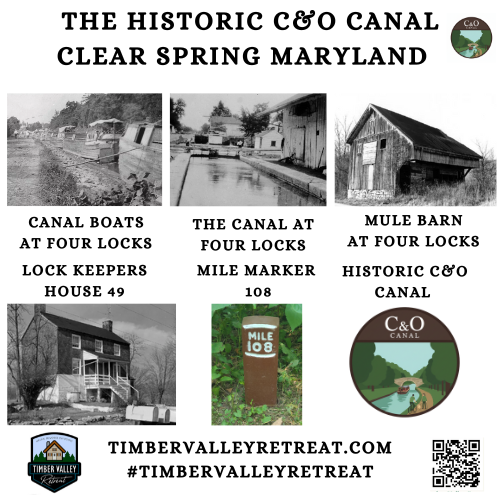
To understand the Charles Mill ruins at Mile 108.13, one must understand the community of Four Locks. Named for Locks 47, 48, 49, and 50, this area was a unique “canal town” that existed because of a massive engineering feat. The canal company decided to cut across the base of Prather’s Neck, a loop in the Potomac River, saving four miles of tedious navigation.
In the 19th century, Four Locks was a bustling village. It wasn’t just a place where boats passed through; it was a place where people were born, worked, and thrived. At its peak, the community boasted:
- Two General Stores: Where families bought everything from calico fabric to salted pork.
- A Post Office: Connecting the remote “Neck” to the rest of Maryland.
- A Schoolhouse: Educating the children of lock-keepers and local farmers.
- The Mule Barn: A vital service station where “freshened” mules were swapped out so canal boats could keep moving toward their destination. 🐴
The Lock-Keeper’s Life: Vigilance at the Gates 🗝️
The heart of this community was the lock-keeper. Living in the sturdy stone houses provided by the Canal Company, these individuals were on call 24 hours a day. When a boatman blew his tin horn, the lock-keeper had to be ready to “swell” the lock, regardless of the weather or the hour.
The relationship between the Charles Mill ruins and the Four Locks community was symbiotic. The mill provided the flour and feed, while the canal provided the transportation and the customers. It was a self-sustaining ecosystem of labor and nature deep in C&O Canal history.
The Impact of the 1889 and 1924 Floods 🌊
The history of this area is also a story of resilience against the power of the Potomac. The great flood of 1889—the same year as the Johnstown Flood—devastated the canal infrastructure. However, the community rebuilt. It wasn’t until the 1924 flood that the canal finally ceased commercial operations.
When the boats stopped moving, the village of Four Locks slowly began to fade, leaving behind the beautiful Charles Mill ruins and quiet trails we enjoy today. Walking through the “Enchanted Forest” toward the ruins, you can almost hear the echoes of the mule teams and the shouts of the boatmen from the golden age of C&O Canal history.
Preserving the “Green” Peace of History 🌿
Today, the National Park Service maintains the Four Locks area as a historic site, but at Timber Valley Retreat, we consider ourselves the unofficial guardians of the “quiet side” of this history. We want our guests to feel the weight of these centuries. The C&O Canal Trust provides excellent maps and resources for those wishing to dive deeper into the daily lives of these canal families.
When you sit by the Big Spring Run today, you are sitting by the same water that once powered a community’s dreams. We are so blessed to share this “green” sanctuary where history and nature are finally at peace with one another. ✨
🌄 A Sanctuary Awaits at Timber Valley Retreat
Escape the everyday and discover true tranquility at Timber Valley Retreat. Nestled amidst rolling hills and lush, whispering woods, our retreat offers an idyllic haven where the stress of modern life simply melts away. Breathe deep the clean country air and let the serene natural beauty rejuvenate your soul. Whether you seek a quiet weekend of reflection, a romantic getaway, or simply a chance to reconnect with nature, our cozy accommodations provide the perfect backdrop for unforgettable memories. At Timber Valley Retreat, every visit is an invitation to pause, unwind, and embrace the peace.
Read our guests’ heartfelt experiences here: https://timbervalleyretreat.com/heartfelt-testimonials/
Book your stay directly from our website and save all the booking fees: https://timbervalleyretreat.com/book-your-stay/ 🌲

#TimberValleyRetreat #CharlesMillRuins #COCanal #MarylandHistory #ClearSpringMD #VisitMaryland #PotomacRiver #HistoricMaryland #GlampingLife #NatureRetreat #FourLocks #Mile108
An official production of Timber Valley Retreat.
All rights reserved.