
C&O Canal & B&O History – Few people realize that one of America’s greatest transportation rivalries began on Independence Day.
On July 4, 1828, two groundbreaking projects officially began construction—the Chesapeake & Ohio (C&O) Canal and the Baltimore & Ohio (B&O) Railroad. Their shared mission was ambitious: connect the growing eastern cities with the expanding American frontier. What followed was decades of fierce competition that forever shaped commerce, transportation, and the communities of Western Maryland.
Today, visitors staying at Timber Valley Retreat can still experience this remarkable history. From walking beside the historic C&O Canal Towpath to biking the Western Maryland Rail Trail, guests have the unique opportunity to explore landscapes where canals, railroads, and the Potomac River all played vital roles in building our nation.
The echoes of that rivalry are still visible throughout Washington County, making this one of the most fascinating chapters in American history to discover during your visit to Western Maryland.
C&O Canal & B&O History – A Historic Race Begins on July 4, 1828
As Americans celebrated Independence Day in 1828, another milestone was unfolding that would influence the nation’s future for generations. On July 4, two monumental transportation projects officially broke ground—the Chesapeake & Ohio (C&O) Canal and the Baltimore & Ohio (B&O) Railroad.
Both projects shared a common dream: create a dependable transportation route between the East Coast and the Ohio River Valley. At the time, moving goods over the rugged Appalachian Mountains was slow, expensive, and often unreliable. A faster route meant greater economic growth, new settlements, and stronger connections between communities.
The C&O Canal was designed to carry coal, lumber, grain, and other cargo aboard canal boats pulled by mules walking along the towpath. The canal promised a steady, efficient means of transporting large quantities of freight using the natural path of the Potomac River.
The B&O Railroad, however, embraced a revolutionary technology. Steam-powered locomotives could travel faster than canal boats, operate throughout the year, and continue improving as railroad engineering advanced.
Although both projects began with tremendous optimism, history would reveal that they were not simply transportation systems—they were competitors racing to shape America’s future. Much of that competition unfolded right here in Western Maryland, where the narrow Potomac River corridor forced the canal and railroad to share the same landscape.
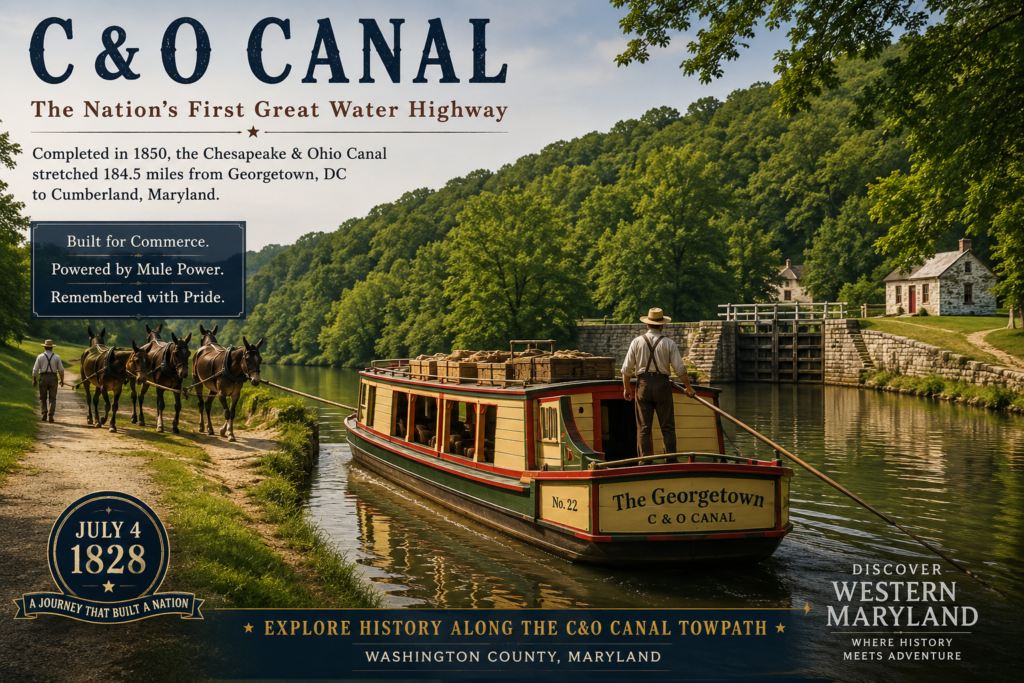
Historic mule-drawn canal boat traveling along the Chesapeake & Ohio Canal beside the towpath on a peaceful summer day, illustrating the transportation history that began on July 4, 1828, in Western Maryland.
Why the C&O Canal and B&O Railroad Became Fierce Rivals
Although the Chesapeake & Ohio (C&O) Canal and the Baltimore & Ohio (B&O) Railroad shared the same goal, they quickly became fierce competitors. Both wanted to move people and products between the East Coast and the expanding western frontier, and both depended on the narrow Potomac River corridor through Western Maryland.
Surveyors, engineers, and construction crews often found themselves competing for the same right-of-way along steep mountainsides and riverbanks. In some locations, legal disputes and engineering challenges determined whether the canal or the railroad would claim the limited space.
For many years, each transportation system offered unique advantages. The C&O Canal excelled at moving large quantities of coal, lumber, grain, and other heavy cargo at a relatively low cost. Canal boats, pulled by teams of mules along the towpath, became a familiar sight throughout the Potomac Valley.
The B&O Railroad, however, continued to evolve. As steam locomotives became faster, stronger, and more reliable, rail transportation dramatically reduced travel times. Unlike the canal, which could be affected by floods, droughts, or winter ice, trains operated throughout much of the year and could transport both passengers and freight with increasing efficiency.
By the late 1800s, the advantages of rail transportation became impossible to ignore. While the C&O Canal remained an engineering marvel and served the region faithfully for decades, the B&O Railroad had transformed the future of American transportation.
Today, visitors exploring the C&O Canal Towpath and the Western Maryland Rail Trail can still witness where these two remarkable transportation systems once competed side by side. It’s a living history lesson that continues to inspire visitors from around the world.
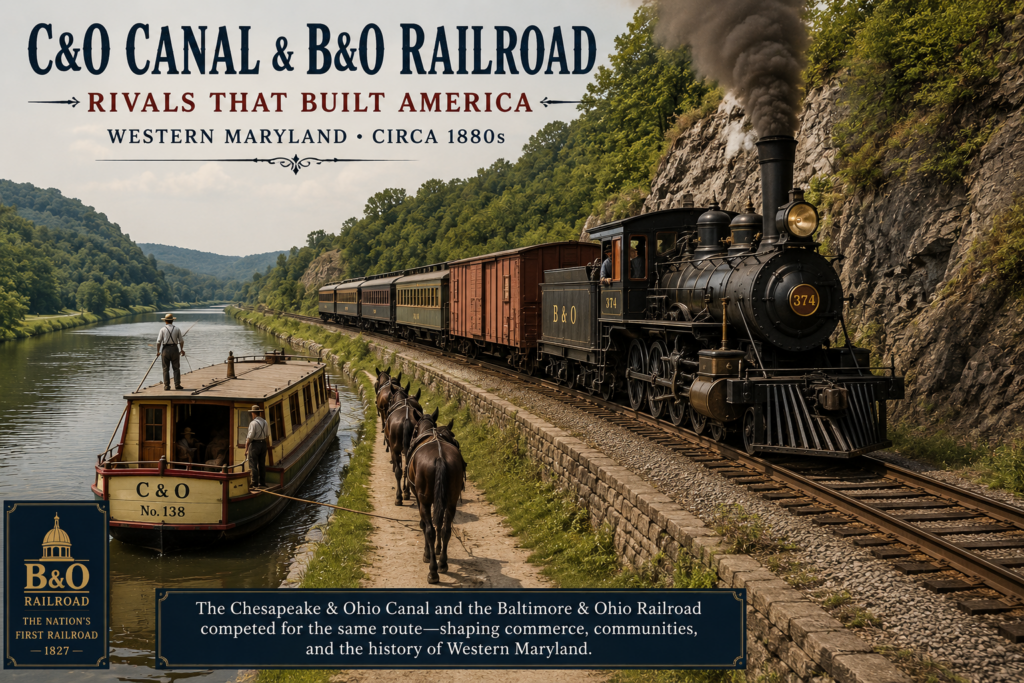
Why the C&O Canal and B&O Railroad Became Fierce Rivals
Although the Chesapeake & Ohio (C&O) Canal and the Baltimore & Ohio (B&O) Railroad shared the same goal, they quickly became fierce competitors. Both wanted to move people and products between the East Coast and the expanding western frontier, and both depended on the narrow Potomac River corridor through Western Maryland.
Surveyors, engineers, and construction crews often found themselves competing for the same right-of-way along steep mountainsides and riverbanks. In some locations, legal disputes and engineering challenges determined whether the canal or the railroad would claim the limited space.
For many years, each transportation system offered unique advantages. The C&O Canal excelled at moving large quantities of coal, lumber, grain, and other heavy cargo at a relatively low cost. Canal boats, pulled by teams of mules along the towpath, became a familiar sight throughout the Potomac Valley.
The B&O Railroad, however, continued to evolve. As steam locomotives became faster, stronger, and more reliable, rail transportation dramatically reduced travel times. Unlike the canal, which could be affected by floods, droughts, or winter ice, trains operated throughout much of the year and could transport both passengers and freight with increasing efficiency.
By the late 1800s, the advantages of rail transportation became impossible to ignore. While the C&O Canal remained an engineering marvel and served the region faithfully for decades, the B&O Railroad had transformed the future of American transportation.
Today, visitors exploring the C&O Canal Towpath and the Western Maryland Rail Trail can still witness where these two remarkable transportation systems once competed side by side. It’s a living history lesson that continues to inspire visitors from around the world.
The Lasting Legacy of the B&O Railroad and C&O Canal
Today, the Baltimore and Ohio Railroad and the Chesapeake and Ohio Canal National Historical Park are no longer rivals racing to move freight between the East Coast and the Ohio Valley. Instead, they stand together as two of America’s greatest transportation landmarks, telling the remarkable story of innovation, determination, and westward expansion.
Visitors exploring Western Maryland often have the unique opportunity to experience both pieces of history on the same trip. In many places, the former B&O Railroad right-of-way and the historic C&O Canal run side by side along the Potomac River, creating one of the most scenic transportation corridors in the nation.
For history enthusiasts, photographers, hikers, cyclists, and families, the corridor offers an unforgettable journey through nearly two centuries of American engineering.
Where You Can Still Experience This History
Several locations allow visitors to see firsthand how closely these transportation systems were connected:
- Hancock – Railroad tracks and canal towpath remain close together.
- Big Pool – Peaceful canal scenery with nearby railroad operations.
- Williamsport – Historic canal structures alongside railroad history.
- Harpers Ferry National Historical Park – One of the most photographed locations where railroad, canal, and river converge.
- Paw Paw Tunnel – A marvel of canal engineering located near historic railroad routes.
- Cumberland – The western terminus of the C&O Canal and an important railroad hub.
Each destination offers a unique perspective on how transportation evolved throughout the 1800s. Timber Valley Retreat, C&O Canal & B&O History, Western Maryland Rail Trail
From Competition to Preservation
Ironically, the fierce competition that once existed between the canal and the railroad has become one of the region’s greatest tourism assets.
Today, visitors can:
- Bike the historic towpath.
- Watch modern freight trains roll past.
- Visit preserved locks and aqueducts.
- Explore historic railroad stations and museums.
- Photograph locomotives traveling beside one of America’s best-preserved canals.
- Learn how both transportation systems helped shape the growth of the United States.
The very landscapes that once echoed with the sounds of mule teams, canal boats, whistles, and steam locomotives now provide peaceful opportunities to reconnect with America’s industrial heritage.
How the B&O Railroad Changed American Transportation Forever
As the 1800s progressed, the Baltimore & Ohio (B&O) Railroad proved that rail transportation represented the future. Steam locomotives could travel farther, faster, and more frequently than canal boats while carrying both passengers and freight across the growing nation.
Unlike the Chesapeake & Ohio (C&O) Canal, which depended on water levels and was vulnerable to floods, droughts, and winter ice, the railroad offered a more dependable transportation system throughout much of the year. Improvements in locomotive technology allowed trains to climb steeper grades, haul heavier loads, and dramatically reduce travel times.
By the late nineteenth century, railroads had become the backbone of American commerce. Communities expanded around rail lines, industries flourished, and goods that once required days or weeks to move by canal could now reach their destinations in a fraction of the time.
Although the C&O Canal gradually declined as commercial transportation shifted to the rails, its story did not end. Today, both transportation systems remain treasured pieces of American history. The canal has been preserved as part of the Chesapeake & Ohio Canal National Historical Park, while many former railroad corridors have found new life as recreational trails.
One of the finest examples is the Western Maryland Rail Trail. Built along the former Western Maryland Railway corridor, the paved trail allows visitors to walk, run, and bicycle where trains once carried passengers and freight through the beautiful Potomac River valley. Together with the nearby C&O Canal Towpath, these historic routes offer an unforgettable journey through the transportation history of Western Maryland.
Continue Discovering Timber Valley Retreat
Every season and every sunset tells a different story at Timber Valley Retreat. If you enjoyed learning about the magic of golden hour, we invite you to continue exploring the places and experiences that make our 100-acre retreat so special.
Continue Your Journey
Book your stay at https://timbervalleyretreat.com/book-your-stay/ Timber Valley Retreat, C&O Canal & B&O History, Western Maryland Rail Trail.

Heartfelt Guest Testimonials
https://timbervalleyretreat.com/heartfelt-testimonials/
Discover the Timber Valley Journal
https://timbervalleyretreat.com/timber-valley-retreat-blog/
Every visit reveals another story waiting to be discovered.
Helpful Resources
National Weather Service
https://weather.gov/
Maryland Department of Natural Resources
https://dnr.maryland.gov/
Chesapeake & Ohio Canal National Historical Park
https://www.nps.gov/choh/
Family Owned • Family Operated
Creating memories across 100 Acres of Experiences.
© Timber Valley Retreat. All rights reserved.
An official production of Timber Valley Retreat, C&O Canal & B&O History, Western Maryland Rail Trail. All rights reserved.